How can Optical Tensiometry Characterize Coatings?
涂料用于修改其覆盖的底物的特性,并在我们的日常生活中无处不在。它们可以具有功能性,保护性和/或审美目的。涂层的日常示例是智能手机上的触摸屏。这些屏幕上的涂层排斥油,使手指在表面上很容易滑动。涂料还为基础玻璃提供了一些保护,并使手机看起来有光泽和吸引力。
为了有效执行,必须对其底物进行充分的涂层。这需要涂层和底物之间的良好的润湿性。涂层表面本身的表征同样重要,因为涂层表面应具有预期的粘合剂或驱逐出现的特性。涂层粘附和性能的关键方面可以使用光学张力仪轻松测量。本文重点介绍了五种技术,这些技术允许涂层的开发和表征 - 静态接触角,前进/退化的接触角,倾斜角,表面自由能和3D地形,以进行粗糙度校正的接触角。虽然本文不会详细讨论每个测量的理论或实践,但它将描述这些测量中每个测量方面的意义在涂层粘附和性能方面的意义。向我们的技术页面提供了链接,以允许读者更多地了解每种特定技术的详细信息。
How to determine how well a coating adheres: contact angle measurements
确定涂层粘附底物的基本方法是通过接触角测量. Static contact angle measurements are performed by placing a drop of liquid onto a surface and measuring the angle that the edge of the drop makes with the surface. This angle represents an equilibrium state between the solid, liquid, and vapor surface tensions. Lower contact angles (values approaching 0°) usually indicate better adhesion, and this in turn usually means better coating performance and durability. One can also use contact angle to measure the performance of the coating itself. For example, if one develops a water-repellent (hydrophobic) coating, a high contact angle (> 90°) for a drop of water on the coating would be desirable.

Figure 1: Examples of a droplet on a hydrophobic (left) and hydrophillic (right) surface
Another important use of contact angle measurements is to determine the cleanliness of a surface. Because liquid drops are highly sensitive to the chemical properties of the surface, any changes in the surface chemistry from dirt, debris, oxides, or other contamination can be measured. This is especially important for coatings since applying a coating onto a dirty surface may cause it to fail prematurely. For example, if spots of dust are present on a piece of wood before you paint it, the loosely bound dust may serve as a weak point for the paint adhesion. This could eventually lead to delamination and peeling. Contamination may manifest itself through large variations from spot checks across the surface or differences between the left and right contact angle. Because of this surfaces usually require cleaning treatments prior to the coating application. For contact angle characterization it is routine to wash surfaces with water, or solvents (such as ethanol), followed by drying with an inert gas.
Advancing and Receding Contact Angle
A variation of the contact angle measurement, called the前进和退化的接触角, or dynamic contact angle, can be used to obtain information about the heterogeneity of the surface. In this measurement, instead of placing a single, static drop on the sample surface, a needle is placed in the drop and the volume is slowing increased. As this occurs, the baseline where the drop contacts the surface also steadily increases until it reaches a maximum value. The receding contact angle is measured by withdrawing liquid from the drop, and as its volume decreases the baseline also decreases until a constant value is reached. The difference between the advancing and receding contact angle is called the contact angle hysteresis and is indicative of variations in the surface chemistry and roughness. Characterization of non-adhesive superhydrophobic surfaces (water contact angle > 150°), requires measuring advancing and receding contact angles since surfaces with high static contact angle are not necessarily non-adhesive.

Figure 2: Example of an advancing (left) and receding (right) contact angle measurement. Picture courtesy of Biolin Scientific.
倾斜接触角
Tilting contact angle is a method for determining under what conditions a drop begins to roll off its substrate. The test is performed by either placing the instrument on a tilting cradle and rotating the entire instrument or by using a tilting stage to rotate the sample. As the droplet tilts, the effect of gravity causes it to distort its shape and eventually roll off the sample. The leading edge of the drop is called the advancing contact angle, and the trailing edge is called the receding contact angle.
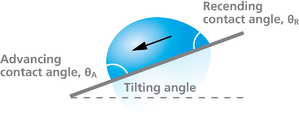
Figure 3: Schematic of a tilting contact angle measurement. Image courtesy ofBiolin Scientific.
尽管这些术语与前面描述的针刺方法相同,但应注意的是,两个测量值的值不一定是相同的,因为倾斜角的结果取决于Drop Volume1。对于粘附测量,这两种技术可以以互补的方式使用。例如,考虑汽车挡风玻璃的涂层。为了获得最佳的可见性,雨滴应滚下挡风玻璃,不要粘在表面上,因此涂层应具有疏水性和无粘性的水。但是,并非每个挡风玻璃都以相同的角度安装。跑车可能与屋顶较浅的挡风玻璃角,而家庭汽车或公共汽车的角度可能更陡。针刺前进,后退和磁滞测量值将提供涂层满足疏水性和非粘附性要求的基本信息,而倾斜角将确认某个尺寸的滴确实以指定角度滚动涂层。
表面自由能
Surface free energy (SFE) is another technique that allows us to determine the chemical properties of our solid, and consequently what types of liquids wet a solid. It characterizes the different intermolecular forces in a surface, such as its polar, dispersive, hydrogen bonding, and acid-base forces, among others. At a high level, surfaces with large SFE values tend to be easily wetted by a range of liquids and are usually hydrophilic. Examples of such materials include metals and ceramics. On the other hand, low SFE surfaces are not easily wetted and include materials like plastics and Teflon.
By using at least two different liquids with known surface tensions, the SFE can be determined. Commonly used liquids include water, di-iodomethane, and ethylene glycol. Depending on the method used to calculate the SFE, information about the polar, dispersive, acid, and base components can be measured. To maximize adhesion between a liquid and its surface, one would want to closely match the values of the polar and dispersive components of the liquid and substrate. There are some instances, such as with inkjet printing, where SFE optimization between the liquid and substrate is preferred instead. Printing on highly adhesive surfaces may cause unrecognizable splotches, whereas poorly adhesive surfaces may lead to beading and smearing of printed droplets2. Surface treatments such asplasma或火焰退火通常用于增加材料的SFE。
Roughness Corrected Contact Angle using 3D Topography
表面粗糙度通常不会在接触角度测量中解释,但可能会对结果产生巨大影响。罗伯特·温泽尔(Robert Wenzel)于1936年成立,粗糙度扩大了表面的润湿性。换句话说,粗糙角度较低的表面在粗糙时的接触角度较低,反之亦然。Wenzel开发了一个方程式,该方程式可以校正粗糙度的影响,以确定完美平坦的表面的接触角,称为roughness-corrected contact angle(RCCA)。实现此测量的第一个商业设备是Attension Theta Flex with Topography, which utilizes a fringe projection phase-shifting method to first measure the 2D and 3D roughness of a surface. A calibrated XYZ sample stage then moves the characterized spot to the liquid dispenser, where a contact angle measurement can be performed on the exact spot where roughness was measured.

Figure 4: An output from a simultaneous contact angle and 3D topography measurement from the OneAttension software.
Examples of benefits from measuring the RCCA using the Theta Flex with Topography include:
- Separating the effect of roughness from the surface chemistry of a contact angle measurement confirms that pre-processing steps like grit-blasting, plasma treatment, or sanding produce the expected roughness and contact angle changes.
- Accurate measurement of Young-Laplace contact angles on real world samples that have texture and roughness eliminates the need to make perfectly flat coatings to properly characterize the contact angle.
- Roughness correction enables more accurate SFE measurements to determine the polar and dispersive properties of a surface.
Conclusion
Overall, optical tensiometry is an indispensable tool for measuring coating adhesion and performance. The different measurements that can be performed as well as their relevance to adhesion is listed in the table below.
| Technique | Use to Measure |
|---|---|
| Static Contact Angle | Cleanliness, Wettability |
| Advancing and Receding Contact Angle | Adhesion, Heterogeneity |
| 表面自由能 | Chemical Interactions Between Liquids and Surfaces |
| 倾斜角 | 在特定条件下的粘附 |
| Roughness-Corrected Contact Angle | 接触Angle Independent of Roughness Features |
TheAttension Theta Flexis a versatile, modular optical tensiometer that can perform all the above measurements with high sensitivity and reproducibility. To learn more about the features of the Attension Theta Flex and how it can be used for adhesion, please view our on-demand webinar.
- [1] Pierce, E.; Carmona, F. J.; Amirfazli, A. Understanding of Sliding and Contact Angle Results in Tilted Plate Experiments. Colloids Surf. Physicochem. Eng. Asp. 2008, 323 (1–3), 73–82.
- [2] Matavž, A.; Bobnar, V.; Malič, B. Tailoring Ink–Substrate Interactions via Thin Polymeric Layers for High-Resolution Printing. Langmuir 2017, 33 (43), 11893–11900.